
Support with overpayments -Carer’s Allowance
If you are worried about Carer’s Allowance overpayments, you are not alone. We have tried to answer some of your main concerns and offer support. For more information about what they are, see our page on Carer's Allowance and overpayments.
What is an overpayment?
An overpayment is when you receive more money than the amount you should have been paid, usually for a certain benefit like Carer’s Allowance.
When claiming a benefit like Carer’s Allowance, it’s important to remember you have a responsibility to keep the Carer’s Allowance Unit (Disability and Carers Service in Northern Ireland) informed of changes to your circumstances as these could affect your entitlement.
Dealing with Carer's Allowance overpayments
These questions and answers may be relevant to you if you have been claiming Carer’s Allowance while also working in an employed position, and are concerned that you have received an overpayment.
One of the conditions for claiming the benefit that can cause some confusion is the earnings limit. You need to ensure that you don’t earn more than £196 per week (from 7 April 2025) after allowable deductions. Known as the main benefit for carers, Carer’s Allowance is currently £83.30 per week (2025/26).
Answering your questions
To help offer support, we have answers to some common questions and concerns below.
See further below for details about the government's Carer’s Allowance overpayments reassessment exercise. Any reassessment as part of this exercise shouldn’t affect your current Carer’s Allowance claim.
Keep track of earnings
It can be difficult to keep track of your earnings and be sure you are keeping under the earnings threshold, and mistakes can be made.
It is better not to wait
If you are concerned that you may have been overpaid Carer's Allowance, it’s important to deal with this as soon as possible. You may want to put it to the back of your mind, but the Department for Work and Pensions will probably realise there’s an error sooner or later. The longer any overpayment goes on, the more you’ll end up having to pay back and the consequences can get more serious.
Check the earnings limit
If you are concerned that you may be earning too much, it’s worth reminding yourself what the earnings limit is each year as it can change each April. Currently it's £196 after allowable deductions (25/26).
It might be helpful to follow these steps:
- Check your net earnings (those without tax and national insurance contributions) are below the threshold.
- Check whether there are any deductions that can be made to your earnings and whether the Carer's Allowance Unit have been made aware of these deductions. These allowable deductions might mean that you are below the threshold and can still get Carer’s Allowance so do check.
- Find out more about the earnings limit on our website here.
Seek specialist advice
If you are concerned that you may have exceeded the earnings limit, it's a good idea to seek some local advice to see where you stand. If you have been overpaid, you will need to let the Carer's Allowance Unit know and keep a record that you have updated them – this is very important. In Northern Ireland, contact the Disability and Carers Service, ‘Carer’s Allowance’ team.
It's advisable to keep your own records
They may suspend your claim whilst they look into it and may ask you to provide more information. If you phone the Carer's Allowance Unit to report your concern, make a note of when you have called them (ie, time and date) and what you told them.
Or if you report a change online, make sure you keep a copy of the email acknowledgement and a note of what you sent them. If possible, take screenshots or photos of each page as you go along when you complete the online report. This is a good idea because you will not otherwise receive a copy of the content of your online report.
Keep a copy of any letter that you send so you are able to keep track of what’s been said and when.
By notifying the Carer's Allowance Unit, you have fulfilled your duty to keep them updated about your circumstances, but it’s a worry when you don’t hear back.
Check that they have received your notification by phoning them and keep a note of the telephone conversation. Keep any email acknowledgement you have if you reported the change in your circumstances online.
It’s a good idea to set the money on one side until this has been dealt with as if there has been an overpayment, the Department for Work and Pensions (DWP) will ask for the money to be repaid. If this is the case and there is a recoverable overpayment, you will then have the money available to repay the DWP.
Contact StepChange if you are worried about how this will affect your finances and be careful to avoid online unregulated advice operators who may overpromise support or personalised solutions. If you receive an overpayment notice (because you have not notified them about a change in your circumstances), check the dates and amount that they say has been overpaid is correct. If necessary, seek advice from a local advice agency about whether the overpayment could be challenged: https://advicelocal.uk/find-an-adviser
The Carer's Allowance Unit do not appear to have an email address. You can report a change of circumstance to them online or you can contact them by phoning 0800 731 0297 (Textphone: 0800 731 0317). You can also write to:
Carer's Allowance Unit
Mail Handling Site A
Wolverhampton
WV98 2AB.
In Northern Ireland, contact the Disability and Carers Service on 0800 587 0912 (textphone: 0800 012 1574) or report a change online.
Don’t assume that if you’ve told another part of the Department for Work and Pensions, other government department, the council, the trust, or HMRC that this information will be passed on.
Do take a note of any phone conversation and keep your email acknowledgement if you report anything online. If writing, keep a copy of your letter and get a certificate of posting.
Questions relating to the government’s 2025 review of overpayments
What did the report uncover?
You may have heard that the government has recently carried out a review into Carer’s Allowance overpayments.
This report has uncovered the need for the Department for Work and Pensions (DWP) to reassess a number of cases, especially relating to some decisions on earnings-related overpayments. It is accepted that some were not correct because guidance on earnings that fluctuate between 2015 and summer 2025 wasn’t clear.
The internal guidance that the DWP decision makers followed did not match the law around averaging of fluctuating earnings.
What happens next?
The DWP has said that it will reassess all overpayment cases in relation to the averaging of fluctuating earnings and people who have overpayments between 2015 and summer 2025. The mistake only affects a relatively small number and if you are affected, you are likely to be contacted directly by the DWP. You don’t have to do anything now and more details will be available from early 2026 when we will update this page. Do continue to notify the DWP of any changes to your circumstances.
Could you be entitled to a refund or reduction?
As a result, the overpayments paid during 2015 and September 2025 by some carers could be reduced or written off. At this point, we do not have information about the timeframe for this, but the DWP has said that most carers will be notified if affected.
The reassessment will also apply to overpayments where people affected are no longer caring.
They have also confirmed that if, during the reassessment exercise, they discover that there has been a higher overpayment than originally calculated, they will not ask anyone for additional money.
You can read the government’s report for more details here.
The Work and Pensions Secretary has confirmed that “most people will have their cases reassessed without needing to contact the Department for Work and Pensions (DWP). Carers who have already repaid their debts will still be able to have their cases reassessed and details on the best way to do this will be set out in due course”(Press release 25th Nov 25). Here is the government’s response.
This reassessment exercise will be carried out by the DWP next year and will take about two years to complete. We will update this page as soon as more details are published, which is likely to be around the beginning of 2026.
Overpayments can arise because of a number of different reasons
The overpayments that will be looked into during this reassessment exercise relate to earnings-related overpayments where averaging wasn’t carried out. It’s a positive and important development but will affect a relatively small number of cases.
If you have a current overpayment, you can seek advice about whether it can be challenged and if so, whether any of the findings of the investigation and accepted recommendations might be helpful to raise in your case.
While the reassessment exercise will look at earnings-related cases going back to 2015, this is different from challenging an overpayment decision where in most cases, there are strict time limits.
You will need to continue paying off the overpayment if you have a payment agreement with the Department for Work and Pensions.
It is just certain overpayments that may have been affected previously by the averaging of earnings that fluctuate, but if you are worried about managing your overpayments, you can contact one of our advisers for guidance using this email address: advice@carersuk.org
If an overpayment has already been settled, a full or partial refund can still be made if you are eligible. If you are no longer caring, your case will still be looked at during the reassessment exercise.
You can still go through with the Mandatory Reconsideration if you are challenging an overpayment decision and have requested one.
Not all overpayments will be affected by the government’s recent review. The recommendation looks at earnings-related overpayments where a person’s earnings fluctuated, but they weren’t averaged out over a defined period.
The Department for Work and Pensions has now improved internal guidance on this aspect of the eligibility conditions so that we are assured it is now in line with the law.
If your earnings fluctuated or you reported your earnings at the time, but the Department for Work and Pensions have no record of this, we would suggest that you share the findings of the independent review with the tribunal: Independent Review of Carer’s Allowance Overpayments - GOV.UK.
If possible, seek help from a local advice agency prior to the hearing to help prepare and to check whether the recommendations of the review might assist your case.

Helpful tip
 Do take a note of any telephone conversation and keep your email acknowledgement if you report anything online.
If writing, keep a copy of your letter and get a certificate of posting.
Unfortunately, different departments in the Department for Work and Pensions do not communicate information to one another in a way that you might expect. You need to contact the department that is paying your benefit to let them know about any changes that might affect your entitlement and keep proof that you have kept them updated. You should always report changes to each department individually.
Yes, it’s vital to keep your own record of any dealings with the Carer's Allowance Unit and also to keep copies of any letters that they send to you.
It's important to be able to show what information you have given to them and when this happened. This helps avoid confusion and allows you to keep on top of managing your claim.
One of the findings of the government’s 2025 review into Carer’s Allowance overpayments is that information provided by carers about their earnings has not been acted on quickly. Keep a detailed note of when you contacted the Department for Work and Pensions including the exact date and time you phoned and content of the call, or the information you sent through the weblink, including the date, time and content.
Information you've sent may be checked
The Carer's Allowance Unit may contact you to make sure they have all the information they need to establish whether they think there has been an overpayment.
They are likely to suspend your Carer's Allowance until they have made a decision about the overpayment and have checked your continuing entitlement to Carer's Allowance. If you are in financial difficulties during this time, you should seek help from a local advice agency.
What happens if they decide there has been an overpayment?
If they decide there has been an overpayment, the Carer's Allowance Unit will write to you and should set out the amount of the overpayment and the dates over which they believe the overpayment happened. If you don’t get full written reasons, you can ask for more details.
Seek support if needed
Once you receive this letter and have details of the overpayment, you can check whether you agree that there has been an overpayment and also whether the total amount that they have asked you to repay is correct and is recoverable.
It can be complicated so if you need help with working this out, you can gather together any relevant information such as payslips and Department for Work and Pension (DWP) letters that you have and make an appointment with a local Citizens Advice or another local advice agency. They will be able to help you to check that the overpayment notice is correct and whether there is any way it could be challenged. You can also find more information on this page.
You will not be expected to pay everything back immediately
It’s a shock and can be very worrying to receive a request to repay money but if you do not have the funds, you will not be expected to repay the whole amount all at once. Money will be deducted from your current benefits or from your earnings if you are working. If you are experiencing difficulties, the amount you repay each month can be negotiated and the debt repaid over a longer period of time.
Get advice
The important thing is to act quickly and seek help from a local advice agency. Once you are satisfied the overpayment notice is correct and the overpayment can be recovered, you can contact the Debt Management Team (details are on the letter you will receive from the Carer's Allowance Unit) to arrange repayment at a rate that shouldn’t cause you or your family hardship. You can get local advice and support if you need to negotiate a lower rate of repayment. The advice agency can also help you find a money adviser if you are struggling with debt.

Helpful tip
If you're feeling anxious about how to pay the money back, there is guidance below to help.
Try not to worry if you don’t have enough money; you will not be expected to repay the overpayment all at once.
Take things one step at a time
Try not to worry if you don’t have enough money; you will not be expected to repay the overpayment all at once. If you’re still receiving benefits, the usual amount you get will be reduced until you have paid back the overpayment. If you are no longer claiming benefits, you will be asked to come to an arrangement with the debt management service which is part of the DWP.
What to expect
You will get a letter from DWP Debt Management explaining how to repay and manage any benefit money you owe. In Scotland, further information is available on the government website here.
What you can do
If the amount they ask for is too much, you can contact the debt management section to discuss your situation. Telephone: 0800 916 0647 (Textphone: 0800 916 0651). Here it can be helpful to have details of your income and outgoings to hand to help them understand your position. A local Citizens Advice or another local advice agency can help with preparing an income and expenditure sheet and may also be able to help you negotiate affordable repayments.
There are a range of options available if a person would suffer hardship. These include temporary suspension of recovery, reduction in recovery rate or in some very limited cases, write-off of the debt.
Remember, if there has been an overpayment in the past, it doesn’t mean that you are not currently entitled to claim Carer's Allowance. If your Carer's Allowance has been suspended, you can ask for it to resume or if the claim was closed, if you are entitled, you can make a further Carer's Allowance claim.
We have a list of free and confidential money advice services on our website here which can also help you get on top of things. Do give them a call if you are worried about your finances including managing the additional burden of repaying an overpayment.
Try not to jump to any conclusions
It’s important to remember that you are not necessarily suspected of fraud because there has been an overpayment. Benefit fraud involves someone acting deliberately or dishonestly when dealing with a benefit authority like the Carer's Allowance Unit. This could be where someone deliberately failed to tell the benefit authority about a change of circumstances so they could get a benefit that they weren’t entitled to.
This means that if you misunderstood, forgot or were unaware of your duty to report a change which meant you were overpaid, you will be asked to repay the money over a period of time and may get a civil penalty but this is different from acting fraudulently. This is when a person deliberately claims benefits that they know they are not entitled to.
Overpayments can happen for a variety of reasons including error on the part of the DWP or because of innocent mistakes or oversights. Remember, overpayments mean that you have been paid too much money not that you have committed benefit fraud.
Could I be prosecuted?
Prosecution for benefit fraud is very different from recovery of an overpayment. If you are suspected of fraud, you may be contacted by a Fraud Investigation Officer or asked to attend an interview under caution. These investigations do not always mean you will be prosecuted, but you will need legal advice before attending the interview.
If you are asked to attend an interview, you will be given at least two weeks’ notice of an interview under caution, so this gives you time to find a legal representative to give you advice and support. Your nearest Citizens Advice can help you find an affordable solicitor who covers this type of work.
There is advice and support for you so however this overpayment has happened, you do not have to try and cope with this alone.
Don't be hard on yourself
Overpayments are generally caused by an innocent error or oversight. You do not have to try to manage this on your own and should get support and advice as soon as you are aware there may be a problem.
There's support available
You can contact us for further information, but for ongoing support we generally suggest you contact your local Citizens Advice or other local advice agency who can talk things through and help you work out your options. Contact them straight away. They will understand how easy it is to have an overpayment and how upsetting and worrying this can be. They will be able to offer you further advice and work out the best options according to your own situation.
Turn to those you can open up to
Understanding that this can feel very unsettling, we also recommend that you talk to someone you trust, especially if this is affecting your health and wellbeing. The Samaritans are available around the clock on 116 123 or by email at jo@samaritans.org
We also have pages with suggestions of ways to look after yourself here: Your health and wellbeing | Carers UK
Reach out to others in a similar situation
On our forum, Carers Connect, you can get in touch with other carers who may be experiencing something similar. You need to be a member to join but it is free to sign up and enables you to get support in other ways. Find out more here.
As a charity, we are also campaigning for reforms to the benefits system to improve the rights of carers. You can read more about our plans here.
Factsheet
You can download the Carer's Allowance factsheet here:
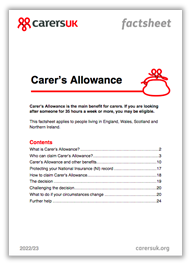
Carer's Allowance April 2025 26
PDF(1050.3MB)
Download